
South Carolina Criminal Court Records
South Carolina criminal court records are public documents held by the Clerk of Court in each of the state's 46 counties. These records cover cases heard in the Court of General Sessions, which handles felonies, serious misdemeanors, and appeals from lower courts. You can search these records online through the South Carolina Public Index, request them in person at any county courthouse, or obtain criminal history data through the South Carolina Law Enforcement Division. This guide explains how the system works and where to find what you need.
South Carolina Criminal Court Records Quick Facts
South Carolina Court System Overview
The South Carolina Judicial Branch oversees a multi-level court system. At the top sits the Supreme Court, followed by the Court of Appeals. Below those appellate courts are the Circuit Courts, which include two divisions: the Court of Common Pleas for civil matters and the Court of General Sessions for criminal cases. Family Courts, Masters-in-Equity, Probate Courts, Magistrate Courts, and Municipal Courts round out the system. Criminal court records in South Carolina flow from these courts and are kept by the Clerk of Court in each county.
South Carolina is divided into 16 judicial circuits. Each circuit covers two to five counties and is served by at least one Circuit Court judge. Judges are elected by the General Assembly and serve six-year terms. They travel a rotating schedule, holding court in different counties within their circuit throughout the year. This circuit system means the Court of General Sessions operates in all 46 counties, with judges moving between them on a set calendar.
The Summary Courts, which include Magistrate and Municipal Courts, serve as the entry point for the state's judicial system. Magistrate Courts handle misdemeanors carrying penalties up to $500 or 30 days in jail, along with preliminary hearings in felony cases. Municipal Courts handle city ordinance violations and minor criminal matters within city limits. Both types of courts conduct bond hearings and bind felony cases over to the Court of General Sessions.
The South Carolina Court Administration manages day-to-day operations across the Judicial Branch. This office oversees the Public Index system, manages court technology, and provides guidance to Clerks of Court on records management. Court Administration also coordinates interpreter services and court reporters who create verbatim records of proceedings.
The website of the South Carolina Judicial Branch serves as the primary online gateway for anyone looking to access court records and case information across the state.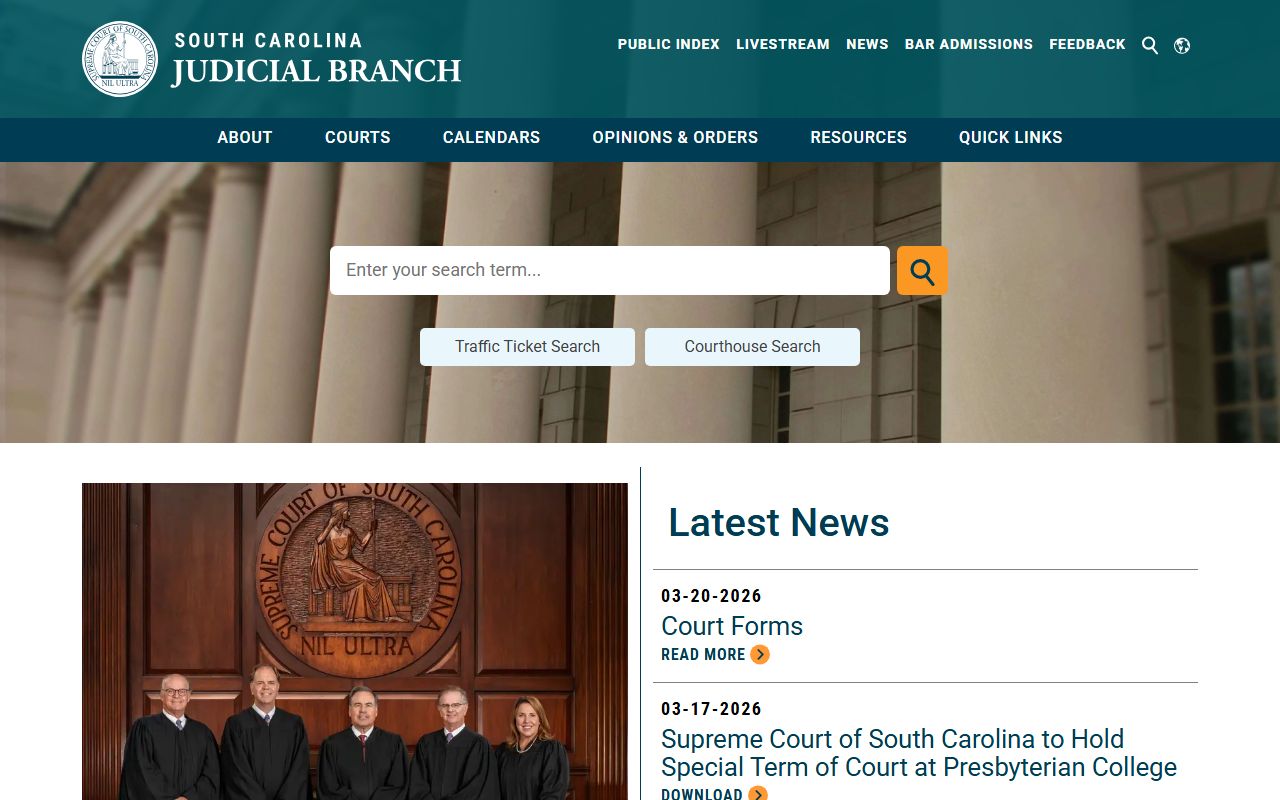
The Judicial Branch redesigned its website to improve transparency and make it easier for residents to find case information, contact clerks, and access court forms in South Carolina.
How to Search SC Criminal Court Records
The fastest way to find South Carolina criminal court records is through the Public Index, the state's official online portal for court case searches. You can search by defendant name, case number, or other identifying details depending on the county. The system is free to use and contains records from both the Court of Common Pleas and the Court of General Sessions for participating counties. Results typically show case summaries, party names, hearing dates, and case status. Some counties also provide document images.
Each county runs its own Public Index database. Search interfaces and available records may differ between jurisdictions. Record availability also depends on how far back each county has digitized its files. The Public Index reflects data entered by individual Clerk of Court offices, so gaps in coverage can occur. If you cannot find a record online, an in-person or mail request to the county courthouse is the next step.
To search in person, go to the Clerk of Court office in the county where the case was filed. The Clerk of Court directory lists contact information and addresses for all 46 county offices. Public access terminals are available at courthouse locations so residents can search records on-site. Staff can assist with locating files and providing copies for a fee. Most offices accept mail requests for records as well.
Note: The Public Index may not include all case types, and certain records involving juveniles or sealed matters are restricted from public view by state law.
Types of SC Criminal Court Records
South Carolina criminal court records include a range of documents generated from the time a case enters the system through its final resolution. Indictments are formal charging documents issued by a grand jury in each county after reviewing evidence presented by the prosecutor. The indictment identifies the defendant, states the charges, and triggers the formal court process. Case files contain all papers filed during a proceeding, including the indictment or information, motions, orders, and the final judgment or sentencing record.
Disposition records show how a case ended. This includes guilty verdicts, not-guilty verdicts, guilty pleas, nolle prosequi entries where the prosecutor drops charges, and dismissals. Sentencing records state the penalty imposed when a conviction results. Bond records show conditions of release set during a preliminary hearing. Arrest records, while generated by law enforcement rather than the courts, often appear in the court file once charges are filed.
Grand jury records document the review process that leads to an indictment. South Carolina grand juries are empaneled in each county to evaluate evidence and determine whether to charge a defendant. Their deliberations are confidential, but the resulting indictment becomes part of the public court record. Appellate records exist for cases that move from the Court of General Sessions to the Court of Appeals or Supreme Court. These records include transcripts, briefs, and appellate opinions.
Under Title 17 of the South Carolina Code of Laws, the criminal procedure statute sets out the rules for how charges are filed, how cases proceed through the courts, and how records are handled. The statute covers arraignments, discovery rules, plea procedures, and appeal timelines. Certain records may be sealed under these provisions, particularly when charges are dismissed or a defendant is acquitted.
South Carolina Circuit Court Criminal Cases
The Court of General Sessions is the circuit-level court that handles serious criminal matters in South Carolina. Its jurisdiction covers all felony cases, major misdemeanors, and appeals from Magistrate and Municipal Courts heard de novo. This means cases appealed from lower courts are tried fresh in the Court of General Sessions without reference to how the lower court decided. The Clerk of Court in each county maintains the official records for this court, including case files, judgment rolls, and execution dockets.
Grand juries are called in each county to review evidence in felony cases. If the grand jury finds probable cause, it issues a true bill, which is the indictment. If it does not find probable cause, it issues a no bill and the case ends. Petit juries selected from voter registration and driver's license records hear criminal cases that go to trial. The Clerk of Court tracks all of these proceedings and keeps the resulting documents as part of the public court record.
Circuit Court records are among the most complete criminal records available in South Carolina. A full case file for a General Sessions case can include the original indictment, pretrial motion papers, trial transcripts, verdict forms, sentencing orders, and post-conviction filings. These records are available through the Public Index or by visiting the county Clerk of Court office.
Note: Circuit Court judges travel a rotating schedule between counties, so court terms in smaller counties may be less frequent than in large urban counties like Richland or Greenville.SLED Criminal Records in South Carolina
The South Carolina Law Enforcement Division serves as the state's central repository for criminal history information. SLED's criminal records database holds fingerprint-based records submitted by local law enforcement agencies, sheriff's offices, and police departments across all 46 counties. These records include arrest information, charges filed, court dispositions, and sentencing data when provided by the courts. SLED collaborates with the FBI's Criminal Justice Information Services division to share criminal history data across state lines.
Individuals can request their own criminal history record directly from SLED to review what is on file. SLED offers both name-based and fingerprint-based searches. Fingerprint-based searches are more accurate because they use biometric verification to confirm identity. Name-based searches may return records for individuals with similar names. SLED charges fees for these searches, with costs varying based on the type and purpose of the request.
The SLED website at sled.sc.gov is the direct source for requesting criminal history records and learning about the agency's services.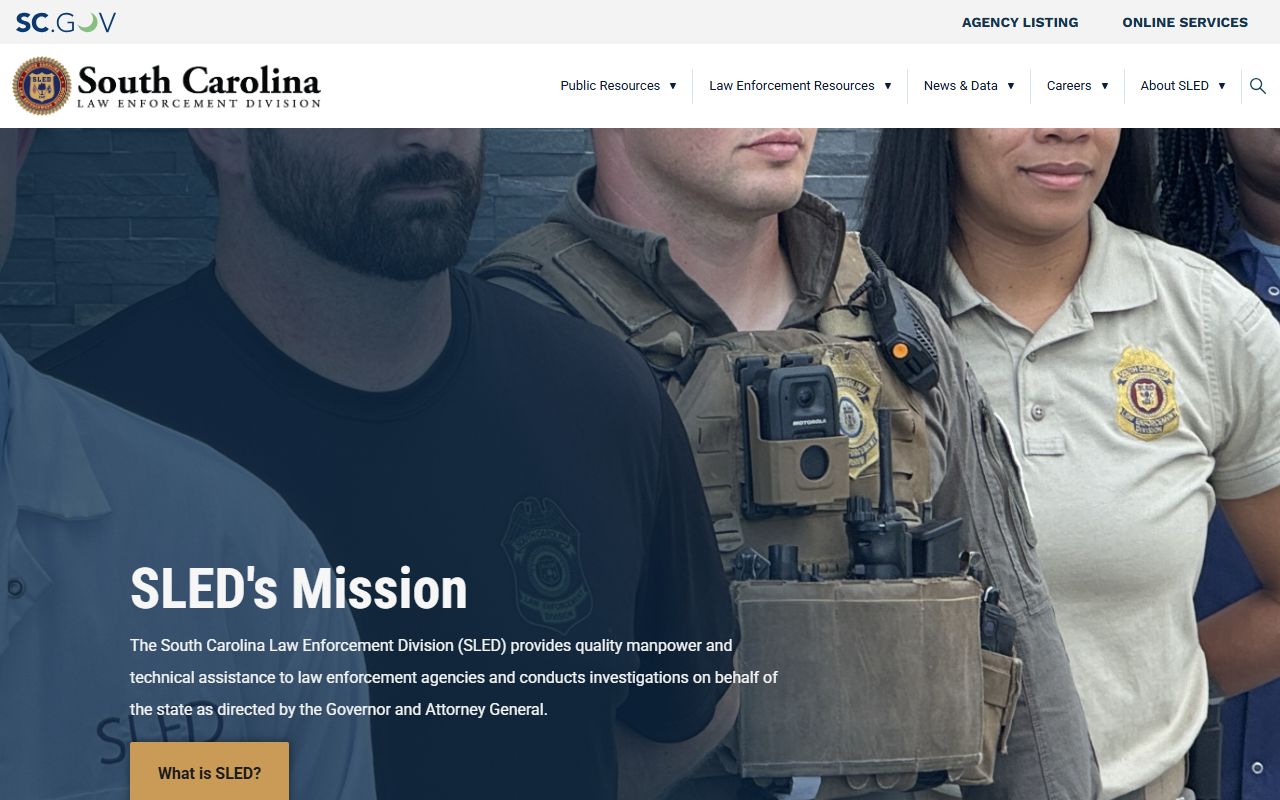
SLED also maintains a Victim Notification System that gives crime victims updates about offender custody status and court proceedings in South Carolina.
When an expungement is granted by a court, SLED is required to update its database to reflect the expunged status of the eligible records. The agency also provides specialized records services for certain licensed professions that require state criminal history checks. Record expungement does not happen automatically through SLED; it must be initiated through the courts.
Note: SLED criminal records reflect data submitted by courts and law enforcement agencies, so processing delays can occasionally result in records that are incomplete or not yet updated.
South Carolina State Archives Court Records
The South Carolina Department of Archives and History is the official repository for historical state government records, including court records dating back to the colonial period. Researchers looking for criminal court records from the 18th and 19th centuries will find relevant collections here. The Archives holds Court of General Sessions records from that era, documenting criminal proceedings from South Carolina's early history. It also maintains records from predecessor courts such as the Court of Chancery and the Court of Appeals in Equity.
Researchers can access records through the Archives' Research Room in Columbia, which provides supervised access to original documents and microfilm copies. Many records have been digitized and are available through the Archives' online database for remote access. Online finding aids help researchers navigate collections by county, date range, and record type. Staff archivists can help explain historical legal terminology found in older documents and guide researchers to the right collections.
The South Carolina Department of Archives and History website offers finding aids and details on accessing historical court records from across the state.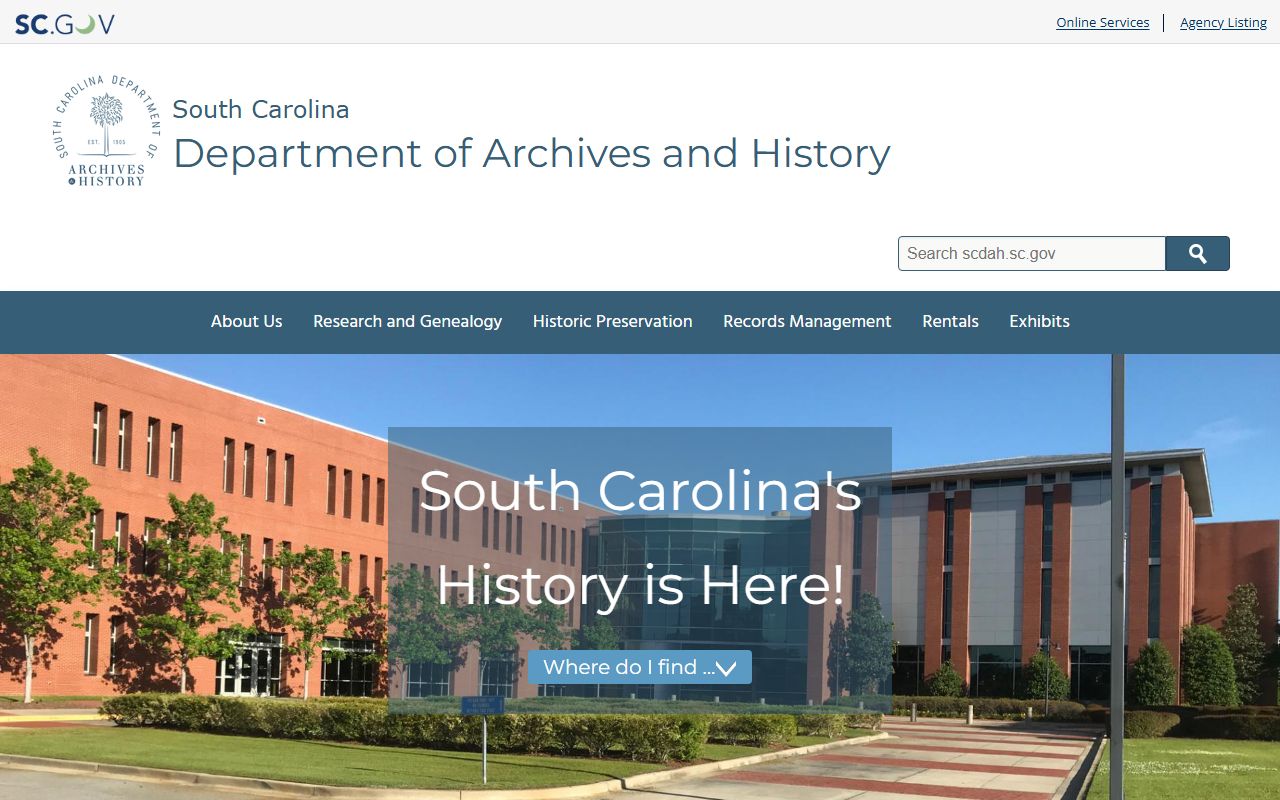
The Archives also provides reproduction services for researchers who need copies of historical court documents for legal, genealogical, or other research purposes.
South Carolina Criminal Procedure and Court Rules
Title 17 of the South Carolina Code of Laws governs criminal procedure from arrest through final disposition. Chapter 1 covers the institution of criminal proceedings, including requirements for warrants, indictments, and informations as charging documents. The statute outlines preliminary hearings where defendants may challenge probable cause for their arrest. Arraignment rules require defendants to be informed of charges and enter a plea of guilty, not guilty, or nolo contendere.
Discovery rules under Title 17 require the prosecution to disclose evidence to the defense, including witness statements, physical evidence, and exculpatory materials. The code distinguishes between misdemeanors and felonies and sets different procedural requirements and penalties for each. Victims' rights provisions require courts to notify victims of proceedings and give them the right to be heard at sentencing. These procedural rules generate the court records that eventually become part of the public record maintained by the Clerk of Court.
The South Carolina criminal procedure statute is available in full on the SC Legislature website for anyone who wants to review how cases move through the courts.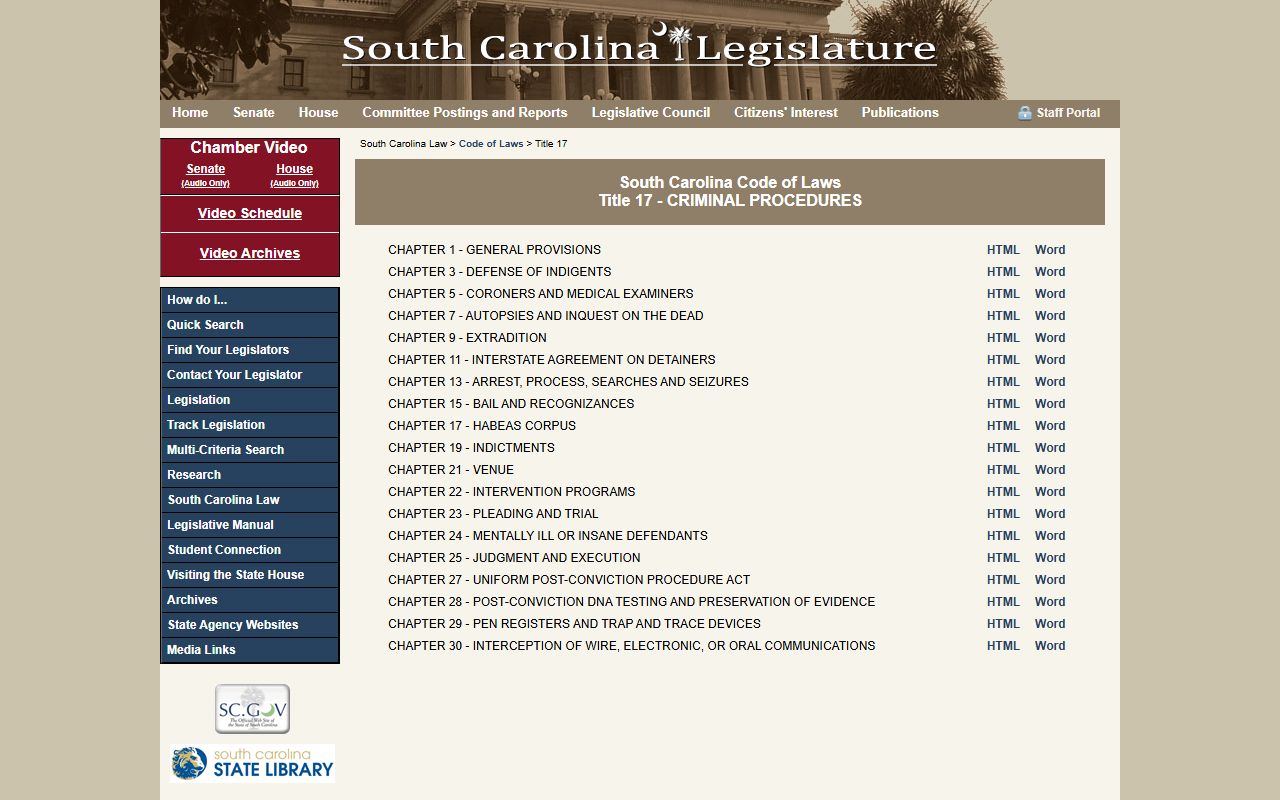
Understanding the steps in Title 17 helps researchers and attorneys know which types of records are created at each stage of a criminal case in South Carolina.
Expungement of SC Criminal Records
South Carolina law allows eligible individuals to have certain criminal records destroyed and removed from public access through a process called expungement. The South Carolina Courts expungement page explains the process and eligibility rules. First-time misdemeanor convictions for non-violent offenses may qualify after a waiting period, provided the person has no subsequent convictions. Charges that were dismissed, nolle prosequi, or resulted in not-guilty verdicts are generally eligible. Successful completion of pre-trial intervention or alcohol education programs may also make a person eligible.
The expungement process starts with filing a petition in the court where the original charge was heard. The Solicitor's Office in each judicial circuit reviews the petition and may support or object based on statutory requirements. Applicable fees and supporting documentation must be included with the filing. Not all offenses are eligible, including most felonies, violent crimes, and traffic offenses. Once an expungement is granted, the court orders all relevant agencies, including SLED, to destroy records of the arrest and proceedings.
The process typically takes several months from filing to final destruction of records. During that time, background checks may still reveal the charges. Juvenile records may be eligible under different procedures and timelines than adult records. Official court forms for expungement petitions are available for download from the SC Courts website. Individuals may file on their own or seek help from an attorney through the South Carolina Bar lawyer referral service.
Note: Expungement eligibility depends on the specific offense, the outcome of the case, and the individual's criminal history, so review the statute or consult an attorney before filing.
Public Access to South Carolina Criminal Records
South Carolina criminal court records are generally public. The South Carolina Freedom of Information Act, found at Title 30, Chapter 4 of the state code, gives the public the right to inspect and copy records of public bodies and agencies. This right extends to court records held by the Clerk of Court in each county. You do not have to be a party in the case to access these records. The FOIA requires public bodies to respond to records requests within 15 business days, with extensions allowed for large requests.
Some records are exempt from public disclosure. Juvenile records, sealed court orders, and records from ongoing law enforcement investigations may not be available. Criminal investigative records can be withheld while an investigation is active or if disclosure would harm law enforcement efforts. Courts may also seal specific documents by order when there is good cause to protect a party's rights. Individuals denied access to records may appeal to the appropriate Circuit Court.
Municipal and Magistrate Court records are subject to FOIA as well, though access may be more limited than circuit-level records. Each court and Clerk of Court office sets its own fee schedule for copies. Reasonable fees for searching, retrieving, copying, and transmitting records are permitted under the statute. The South Carolina Attorney General's Office provides guidance on FOIA compliance and may issue advisory opinions on records access questions.
Crime victims have separate rights to information under state law. The South Carolina Attorney General's victim services unit helps victims understand court proceedings, navigate the system, and register for case update notifications.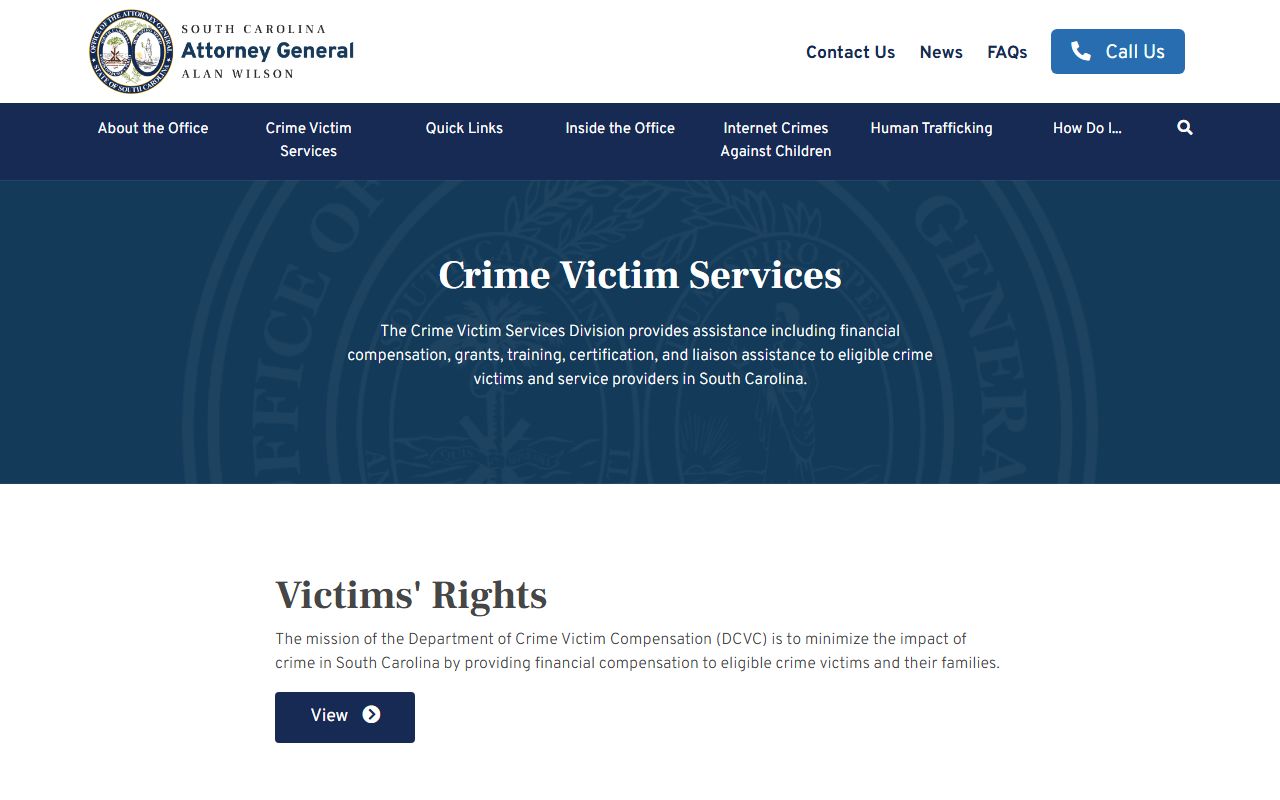
Victims can register for the state notification system to receive updates about defendant custody status, court dates, and case developments throughout the criminal process.
South Carolina Criminal Court Forms
The SC Courts website provides a full collection of standardized forms used in criminal proceedings throughout the state. These are organized by court type, including Circuit Court (General Sessions), Magistrate Court, and Municipal Court forms. Criminal forms include applications for public defender representation, petitions and orders for expungement, bond forms, and motions used in criminal cases. Each form includes instructions for completing and filing it properly.
Forms are available in PDF format and can be downloaded for completion electronically or by hand. Some forms require notarization or a sworn statement before filing with the Clerk of Court. The court forms repository is updated regularly to reflect changes in law and court rules. Spanish versions of commonly used forms are available for certain types of proceedings. Attorneys and self-represented litigants should always use the most current version of a form, as outdated versions may be rejected.
The South Carolina Courts forms page is the official source for downloading current criminal court forms used in proceedings across the state.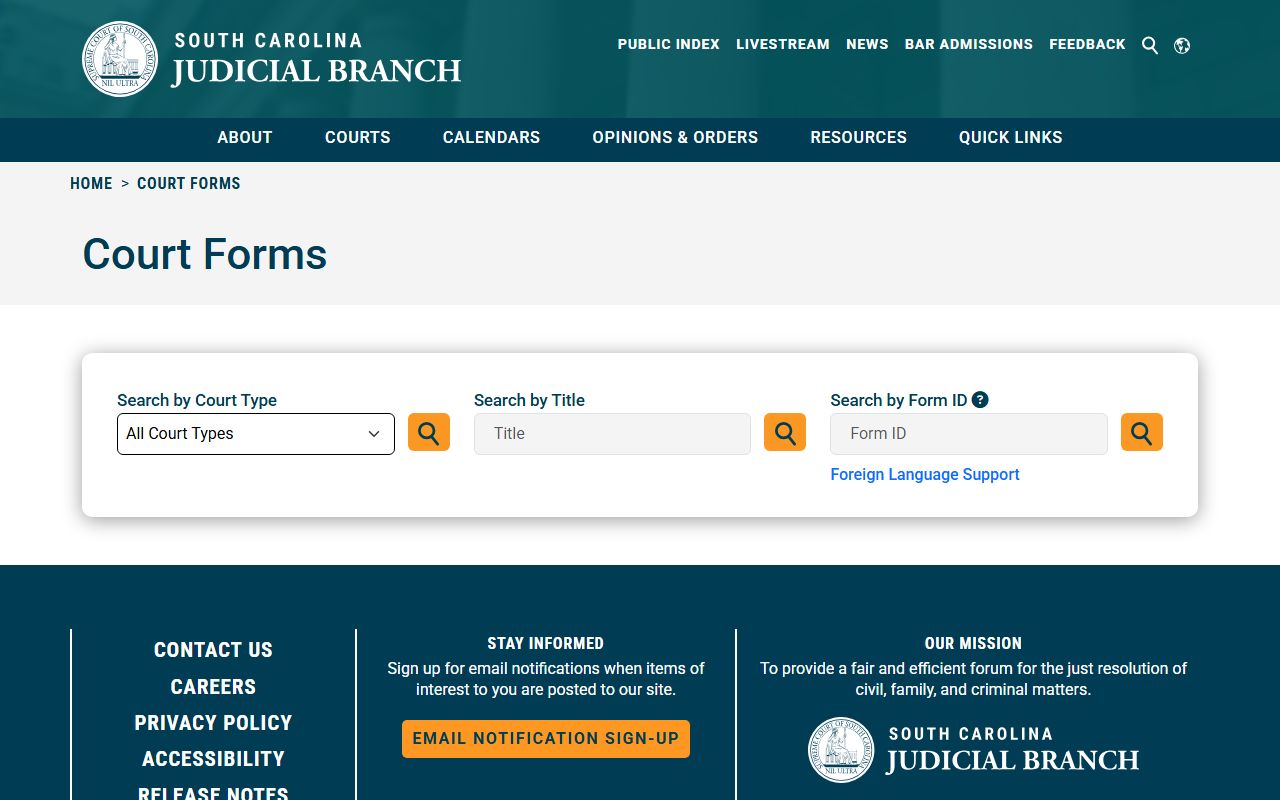
Court Administration works with legal organizations to make forms accessible and understandable for people who choose to represent themselves in South Carolina courts.
Browse SC Criminal Records by County
Each of South Carolina's 46 counties has its own Clerk of Court who maintains criminal court records for cases filed in that jurisdiction. Select a county below to find local resources, contact information, and court record access for criminal cases in that area.
SC Criminal Court Records by City
Major South Carolina cities are served by the Circuit Court in their home county. Select a city below to find criminal court record resources for that area.