
Anderson County Criminal Court Records
Anderson County criminal court records are kept by the Clerk of Court at the Anderson County Courthouse at 100 South Main Street in Anderson, SC. The county is part of the 10th Judicial Circuit and the Court of General Sessions handles all felony cases and serious misdemeanor matters. The public can search these records online through the South Carolina Public Index or by visiting the Clerk's office in person. Case files include indictments, bond documents, motions, plea agreements, trial records, sentencing orders, and disposition details for criminal cases in Anderson County.
Anderson County Quick Facts
Anderson County Clerk of Court
The Anderson County Clerk of Court is the elected official responsible for maintaining all court records for the Court of General Sessions and the Court of Common Pleas. The office is located at 100 South Main Street, Anderson, SC, inside the Anderson County Courthouse. It is open Monday through Friday during regular business hours.
This office maintains criminal case files, manages court dockets, and processes all documents filed in circuit court cases. Public access terminals are available in the Clerk's office for self-service searching during business hours. The Clerk manages jury selection and summoning for trials held in Anderson County. Fees for certified copies, record searches, and other services are set by state law and posted in the office. The Clerk of Court works with the 10th Circuit Solicitor's Office to process criminal cases through the judicial system. Older records may be transferred to the South Carolina State Archives according to state retention schedules.
Visit the Anderson County Clerk of Court website for office contact information and guidance on requesting records. The South Carolina Judicial Branch also provides statewide court resources and direction on accessing court records online.
The Anderson County Clerk of Court is the official keeper of all criminal case records at the courthouse in Anderson.
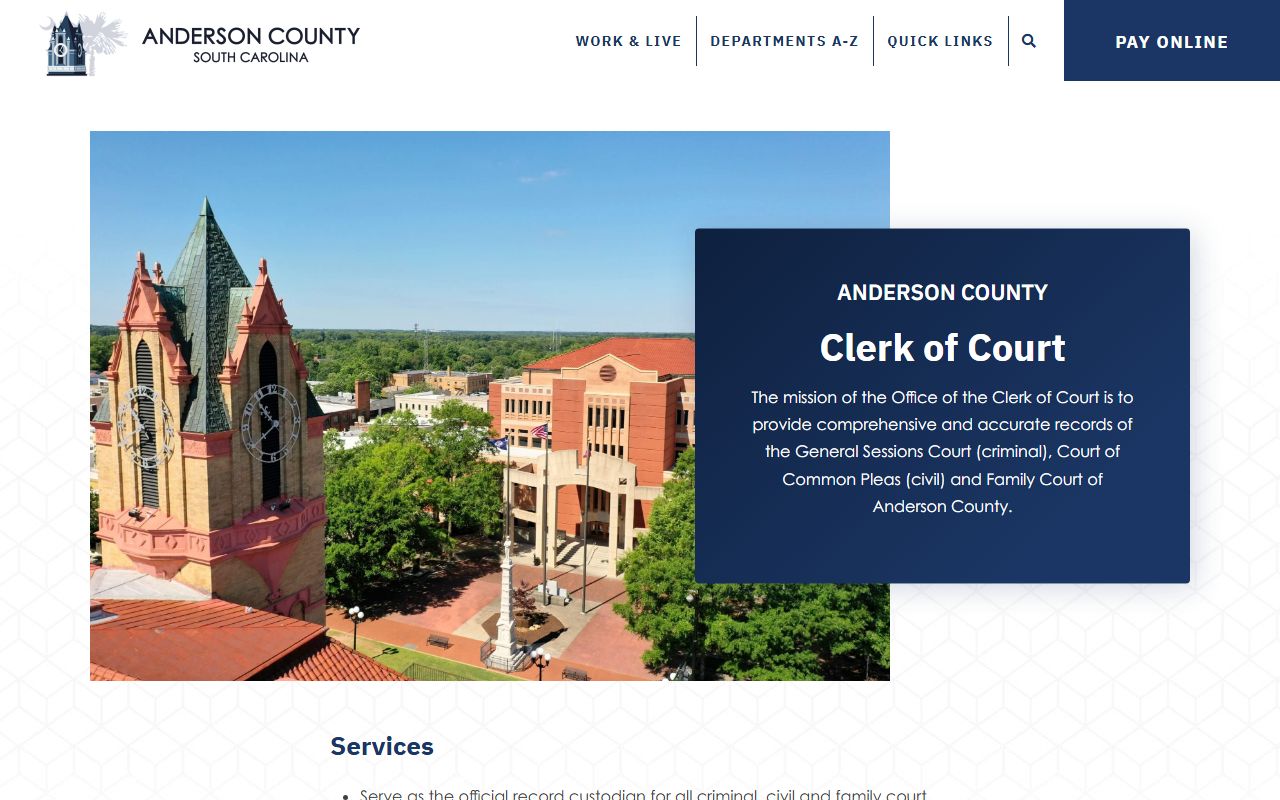
The Anderson County Clerk of Court maintains all official criminal case files at the courthouse, serving as the official custodian of court records for the 10th Judicial Circuit in Anderson County.
Searching Anderson Criminal Court Records
Anderson County provides comprehensive online access to criminal court records through the South Carolina Public Index. The Anderson County Public Index can be searched by defendant name with options to filter by case type, date range, and case status. You can also search by case number using the full designation, such as 2023-GS-04-0001 for a General Sessions case. Results show case summaries including party names, charge descriptions, filing dates, and current disposition status. Anderson County has made significant investments in records digitization, and document images for many cases are available directly through the Public Index without a trip to the courthouse.
In-person searches are available at public access terminals in the Clerk's office. Research assistance is available from staff who can help locate specific documents and explain court procedures. For certified copies, you need a written request, valid identification, and payment of statutory fees. Uncertified copies for personal use cost less. Mail requests are also accepted with the proper information. Records of sealed, expunged, or juvenile matters are not available through public search systems.
Note: Historical records from prior years may be stored off-site and require advance notice for retrieval from the Anderson County Clerk's office.
What Anderson County Criminal Court Records Contain
Anderson County criminal court records cover a wide range of documents tied to felony and serious misdemeanor cases. When a case is filed in the Court of General Sessions, the Clerk of Court creates a case file that grows as the case moves through each stage. These are public documents unless sealed by a court order.
A complete case file in Anderson County may contain the arrest warrant, grand jury indictment, bond documents, pre-trial motions, orders from the court, plea agreement or trial record, sentencing sheet, and any post-conviction filings. Charge descriptions reference the applicable statutes. Court dates, case status, and the presiding judge's name are included. For cases that went to trial, the file contains jury selection records, exhibits admitted into evidence, and the verdict. For plea cases, the agreed terms and factual basis are recorded. South Carolina criminal procedure rules under Title 17 of the state code govern how these documents are created and maintained.
The Clerk's office maintains indices organized by defendant name, plaintiff name, case number, and attorney representation to make searches efficient. The office can also explain filing procedures and record availability, though they cannot provide legal advice.
Court of General Sessions in Anderson County
Anderson County's Court of General Sessions is part of the 10th Judicial Circuit, which covers Anderson and Oconee counties. This court has jurisdiction over felony offenses and serious criminal matters. Circuit judges rotate through the 10th Circuit to hear cases at the Anderson County Courthouse.
Before a case reaches General Sessions, it starts at the magistrate court level. Anderson County Magistrate Courts serve as the initial judicial contact for criminal defendants. Bond hearings are required within 24 hours of arrest by state law. The county is divided into multiple magistrate districts, each with an elected magistrate serving four-year terms. Magistrate courts issue arrest warrants, search warrants, and bench warrants upon a showing of probable cause. Preliminary hearings allow defendants to challenge whether sufficient probable cause exists before the case proceeds to Circuit Court. Anderson County's magistrate courts also adjudicate traffic citations, eviction cases, and restraining order matters. Appeals from magistrate court convictions are heard de novo in the Court of Common Pleas. Anderson County also operates alternative court programs including drug court and veteran's court for qualifying defendants, which aim to address underlying causes of criminal behavior.
Anderson Arrest Records and Sheriff's Office
The Anderson County Sheriff's Office maintains comprehensive arrest records and incident reports for investigations within the county's jurisdiction. The Records Division processes requests for incident reports and can be reached through the Sheriff's Office website or in person. Inmate information is available through an online search system that displays current custody status, booking number, charges, and bond amount. The system updates as inmates are booked, transferred, or released.
The Anderson County Detention Center (ACDC) is a modern facility designed to house over 500 inmates and is accredited by the American Correctional Association. Booking procedures include digital fingerprinting, photographing, medical screening, and risk assessment classification. The facility offers programming including GED classes, substance abuse treatment, vocational training, and religious services. Reentry planning begins upon intake, with case managers working to connect inmates with community resources. Family and friends can deposit funds into inmate accounts through lobby kiosks, online systems, or by mailing money orders. For statewide criminal record data, the SLED criminal records system provides conviction history across South Carolina.
Anderson County Circuit Solicitor's Office
The 10th Circuit Solicitor's Office prosecutes all general sessions criminal cases in Anderson County. The office covers Anderson and Oconee counties. It reviews cases submitted by law enforcement agencies, works with the grand jury to secure indictments, and handles prosecution through trial or plea resolution. Coordination with Anderson County law enforcement agencies ensures cases move forward with the right evidence in place.
The Solicitor's Office provides comprehensive victim services, including case notifications, court accompaniment, and referrals to support organizations. The South Carolina Attorney General's victim resources at scag.gov/crime-victims supplement local services. Pre-trial intervention and diversion programs are available for eligible offenders. Community outreach efforts focus on crime prevention and public safety education throughout the county.
Note: Expungement applications in Anderson County are processed through the Solicitor's Office and Clerk of Court. Details on eligibility are at sccourts.org/courts/expungement.cfm.
Public Records Access in Anderson County
Anderson County complies with the South Carolina Freedom of Information Act under Title 30, Chapter 4 of the state code. Requests for court records go to the Clerk of Court's office at 100 South Main Street. Law enforcement records requests are handled by the Anderson County Sheriff's Office. The county has 15 business days to respond to FOIA requests, though complex requests may require additional time.
Fees for copies are set by state law. Certified copies require payment of statutory fees and proper identification. Some records are exempt from disclosure, including ongoing investigation materials and certain personnel records. Court forms for criminal proceedings are available from sccourts.org/forms. For older records or those transferred to archival storage, contact the Clerk's office in advance to allow time for retrieval.
Cities in Anderson County
Anderson County includes the city of Anderson as its county seat. Criminal cases for residents throughout the county are filed at the Anderson County Court of General Sessions at 100 South Main Street.
Nearby Counties
Anderson County is in the Upstate region and borders several other South Carolina counties. Criminal cases are filed in the county where the alleged offense occurred, so verify the correct jurisdiction before requesting records.