
Find Criminal Court Records in Lexington County
Lexington County criminal court records are public documents filed with the Clerk of Court in Lexington. The county is one of the fastest-growing in South Carolina and sits in the heart of the Midlands region. The 11th Judicial Circuit handles felony criminal cases here through the Court of General Sessions. You can search Lexington County criminal court records online using the Public Index or by visiting the courthouse at 205 East Main Street. This guide walks through the key offices, search tools, and what to expect when looking up records in Lexington County.
Lexington County Quick Facts
Lexington County Clerk of Court
The Lexington County Clerk of Court maintains all official court records for the county. This includes criminal case files from the Court of General Sessions as well as civil matters from the Court of Common Pleas. The Clerk's office is located at 205 East Main Street in the Lexington County Courthouse. It serves as the central point for filing, storing, and retrieving legal documents in Lexington County.
Public access terminals are available at the courthouse for searching court records in person. Staff can assist you in locating criminal case files using a name, case number, or attorney. Certified copies of documents are available upon request for a fee. The Clerk's office also handles jury management services and coordinates court scheduling for Lexington County's busy General Sessions docket. Court fines, fees, and restitution payments may also be submitted through this office.
The Lexington County courthouse sees a high volume of criminal filings each year given the county's large and growing population. The Clerk's staff updates records regularly to reflect new filings, hearings, and dispositions. Getting certified copies from the Clerk is the most reliable way to obtain official criminal court documents in Lexington County.
| Office |
Lexington County Clerk of Court 205 East Main Street Lexington, SC 29072 |
|---|---|
| Hours | Monday through Friday, 8:30 AM to 5:00 PM |
| Website | lex-co.com/clerk-of-court |
How to Search Lexington County Criminal Court Records
Lexington County provides comprehensive online access to court records through the South Carolina Public Index. You can search Lexington County criminal court records at publicindex.sccourts.org/lexington/. The system lets you search by defendant name, case number, or attorney. Results show detailed case information including charges, hearing dates, and current status. Document images are available for many Lexington County cases, making the online system especially useful.
The Public Index is updated regularly by Clerk of Court staff. It is free to use for basic searches. If you need a certified copy of a document, you must contact the Clerk's office directly or visit in person. For general information about the South Carolina court system and how to access records statewide, start at sccourts.org.
In-person searches at the Lexington County Courthouse are the best option when you need to review full case files or obtain certified documents. Bring a valid photo ID. The public access terminals at the courthouse provide the same search tools available online. Staff can help you find older records that may not yet be in the digital system.
Note: While the Public Index covers most cases, some older or sealed Lexington County criminal records may require a formal written request to the Clerk of Court.
What Lexington County Criminal Records Show
Criminal court records in Lexington County are thorough. Each case file starts when a charging document is filed. That document lists the specific charge, the statute allegedly violated, and the date of the offense. Supporting documents such as arrest warrants and indictments are added as the case moves forward. Grand jury proceedings in Lexington County result in true bills or no bills, both of which become part of the record.
Bond hearings and bail conditions are also recorded in the Lexington County case file. Every court appearance is logged, including whether the defendant showed up. Motions from both sides, the court's rulings on those motions, and any continuances are all part of the record. Plea agreements, if reached, are filed with the Clerk and spell out the terms the parties agreed to.
The final disposition is a critical piece of every criminal case file. It records the outcome: conviction, acquittal, or dismissal. Sentencing details follow a conviction and include incarceration length, probation terms, fines, and any conditions of release. All of this information is maintained by the Lexington County Clerk of Court and accessible to the public.
South Carolina criminal procedure is governed by Title 17 of the South Carolina Code of Laws. This title covers everything from arrest to final judgment and shapes how every record in Lexington County is created and stored.
Lexington County Court of General Sessions
The Court of General Sessions is Lexington County's felony criminal court. It operates within the 11th Judicial Circuit alongside McCormick County. Circuit Court judges preside over trials, hear motions, and impose sentences. The court meets at the Lexington County Courthouse and handles a large docket each term.
Felony cases in Lexington County cover a wide range of offenses. Drug trafficking, weapons charges, burglary, assault, and financial crimes are among the matters handled by the General Sessions court. Cases begin at the lower court level before being bound over to General Sessions when the evidence supports a felony charge. The Solicitor's Office then takes over the prosecution. Jury trials in Lexington County are held in the General Sessions court when defendants do not accept a plea deal.
South Carolina Code Title 17 governs criminal procedure statewide, including how General Sessions cases and their records are handled in Lexington County.
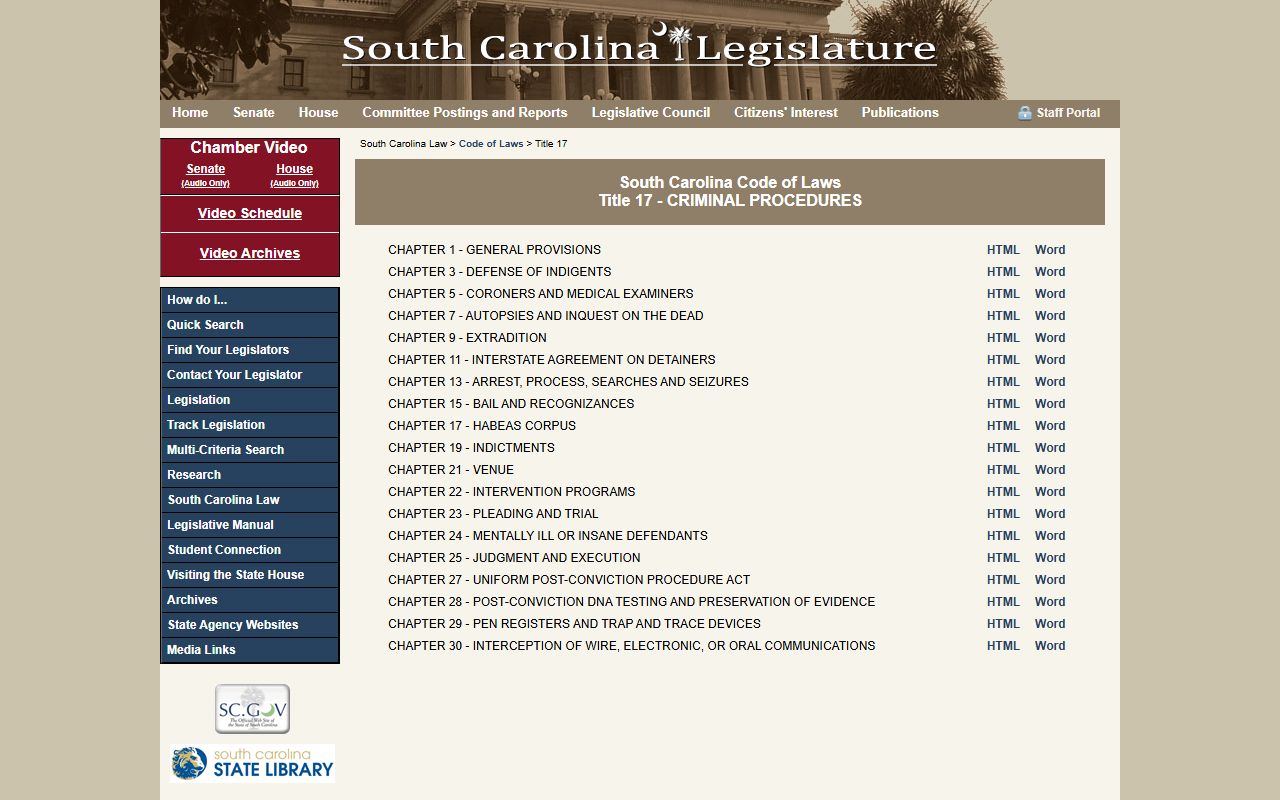
South Carolina criminal procedure statutes at scstatehouse.gov/code/title17.php detail how the General Sessions court operates. Lexington County's large population means the General Sessions docket runs frequently throughout the year. All records from these proceedings are maintained at the Lexington County Clerk of Court.
Lexington County Sheriff and Arrest Records
The Lexington County Sheriff's Office is the county's primary law enforcement agency. It maintains comprehensive arrest records for incidents occurring in unincorporated Lexington County. The Sheriff's Office also operates the Lexington County Detention Center. Booking records from the detention center are public documents that include the arrestee's name, charges, and date of arrest.
An online inmate search is available through the Sheriff's Office website. This tool lets you check the current status of people held at the Lexington County Detention Center. Records requests can be submitted through the Records Division. If you need a copy of an arrest report, contact the Records Division directly.
For a certified statewide criminal history, contact the South Carolina Law Enforcement Division at sled.sc.gov/CriminalRecords. SLED compiles criminal history records from all law enforcement agencies in South Carolina, including Lexington County. These records are used for background checks and are more comprehensive than individual arrest reports.
11th Circuit Solicitor and Lexington County Prosecutions
The 11th Circuit Solicitor's Office prosecutes all felony criminal cases in Lexington County. When the Sheriff or another law enforcement agency makes an arrest, the Solicitor's team reviews the evidence and decides what charges to pursue in General Sessions. The Solicitor also manages pre-trial intervention programs that allow some first-time offenders to avoid a formal conviction.
Victim services are a key part of what the 11th Circuit Solicitor's Office provides. Staff assist crime victims in Lexington County by explaining the court process, sharing case updates, and connecting victims to community resources. Victim advocates attend court proceedings and support victims through each stage of the criminal case.
Note: Pre-trial intervention acceptance is at the discretion of the Solicitor and is not guaranteed. Cases diverted through PTI do not result in a conviction but may still appear temporarily in the Lexington County court record system.
Expungement of Lexington County Criminal Records
South Carolina law provides a path for certain criminal records to be expunged in Lexington County. Expungement seals a record from public view, including the Public Index. Eligible cases include dismissed charges, not-guilty verdicts, and first-offense convictions for specific minor crimes. Prior convictions can affect eligibility.
The process starts with the Solicitor's Office in Lexington County. If the Solicitor approves the application, it goes before a circuit court judge. A successful expungement order removes the record from public databases and notifies SLED to update the statewide system. The timeline varies depending on caseload and any objections raised. Legal assistance can speed up the process and reduce errors in the paperwork.
The South Carolina Judicial Branch explains the expungement process in detail at sccourts.org/courts/expungement.cfm. Blank forms are available at sccourts.org/forms/. Victims and others affected by a proposed expungement have the right to be notified and may object. The South Carolina Attorney General's crime victim resources page explains victim rights in expungement proceedings.
Cities in Lexington County
Lexington County includes several municipalities. All felony criminal cases for county residents are handled at the Lexington County Court of General Sessions. Misdemeanor cases may be handled at the local municipal court level depending on the charge.
The city of Lexington is the county seat. The Lexington County Courthouse is located here, and all General Sessions criminal court records are maintained at this location.
Nearby Counties
Lexington County borders several other South Carolina counties in the Midlands. Criminal cases are filed in the county where the offense occurred. If you are not sure which court handles your matter, check the location of the incident.