
Access Charleston County Criminal Court Records
Charleston County criminal court records cover every felony case, serious misdemeanor, and appeal filed in the Court of General Sessions. As one of the three most populous counties in South Carolina with over 400,000 residents, Charleston County maintains a large and well-organized records system through its Clerk of Court. The county is part of the 9th Judicial Circuit. You can search Charleston County criminal court records online through the county's own Public Index portal, or you can visit the Charleston County Judicial Center in person. Records include case charges, bond information, hearing dates, and final dispositions for all criminal matters filed in the county.
Charleston County Quick Facts
Charleston County Clerk of Court
The Charleston County Clerk of Court is responsible for maintaining all criminal court records for cases filed in the county. The office provides administrative support to the Courts by processing legal actions of both a civil and criminal nature. It keeps and maintains case records including records of judgments for all cases filed in Charleston County courts. The office is located at the Charleston County Judicial Center, a modern facility designed to support the county's large and active court system.
The Clerk of Court collects and disburses money as ordered by the court, including fines, fees, and restitution. Staff schedule civil jury and non-jury trials and maintain hearing schedules for all court divisions. The office also records transcripts of judgment from Small Claims courts and out-of-county judgments that are brought into Charleston County for enforcement. Public access terminals are available during business hours for anyone wishing to search criminal court records on-site.
Jury management is a significant function of the Clerk of Court in Charleston County. The office summons, qualifies, and manages jurors for trials held in the county. This involves coordinating with judges, attorneys, and law enforcement on a daily basis to keep the court calendar moving. The office works closely with the 9th Circuit Solicitor's Office to process criminal cases efficiently and ensure that records are accurate and complete.
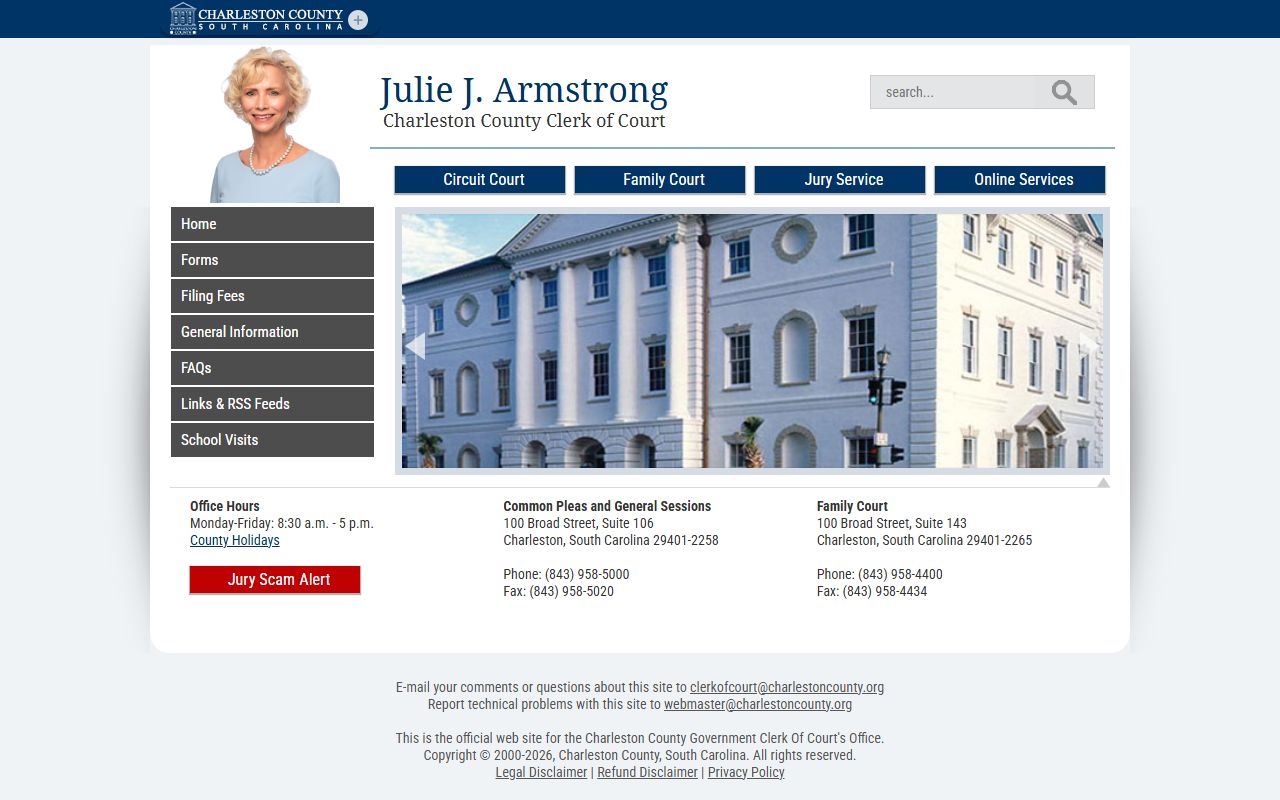
The Charleston County Clerk of Court provides contact information, service details, and guidance for the public on its official county website.
Charleston County has invested significantly in records digitization over the years, which means a large number of criminal court records are accessible online. Older records that predate digital systems may still require an in-person visit, but most cases from recent decades are available through the online portal.
Searching Charleston County Criminal Court Records
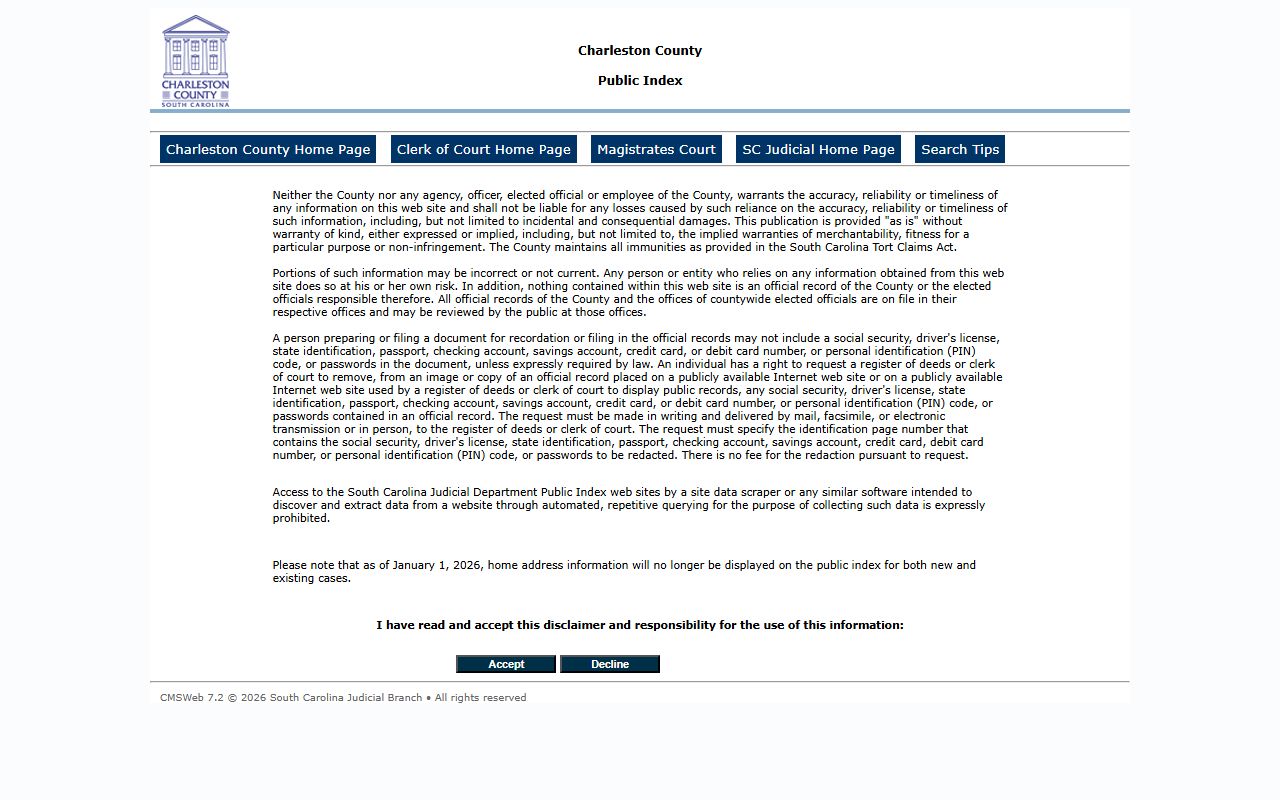
Charleston County operates its own Public Index system at jcmsweb.charlestoncounty.gov/PublicIndex/. This is a comprehensive online portal that allows the public to search criminal cases by defendant name, case number, or other available criteria. The system provides detailed case information including charges, hearing dates, disposition information, and in many cases, images of actual court documents. No account or fee is required for basic searches.
The Charleston County Public Index is updated regularly by Clerk of Court staff to reflect current case status. It runs 24 hours a day, seven days a week, except during scheduled maintenance windows. Users can set up case tracking through the system to receive notifications when case information changes. The system includes both current and historical case data, with the depth of historical records depending on digitization status. Technical support is available through the Clerk of Court's office for users who have difficulty accessing the system.
The Charleston County Public Index is the fastest way to search criminal court records online without visiting the courthouse.
In addition to the county's own portal, the statewide South Carolina Judicial Branch at sccourts.org provides links to court records systems across all 46 counties. For in-person access, visit the Charleston County Judicial Center. Staff can pull physical files and assist you in obtaining certified copies of any document in the record.
Note: Document images in the Charleston County Public Index are available for a broad range of case types, but document availability may vary for very old cases or certain sealed matters.
What Charleston County Criminal Records Contain
Criminal court records in Charleston County are among the most detailed in the state because of the volume of cases processed here and the county's investment in digital record-keeping. A criminal case record begins the moment charges are filed and grows with every subsequent court action. The record reflects every document filed, every hearing held, and every order issued by the court.
Typical contents of a Charleston County criminal court record include arrest warrants and charging documents, grand jury indictments for felony charges, bond hearing records and bond conditions, motions filed by defense attorneys and prosecutors, plea agreements, sentencing orders and probation terms, and any appeals filed with higher courts. Cases that went to trial will also have trial transcripts and jury verdict forms. These documents reflect the full procedural history of a criminal case from initial charge through final resolution.
Most criminal court records in Charleston County are public documents. Access is governed in part by Title 17 of the South Carolina Code, which establishes criminal procedure rules including record-keeping requirements. Records may be restricted for cases involving juveniles, matters under court seal, or cases where an expungement has been granted. For all other adult criminal cases, the record is accessible to any member of the public through the Clerk of Court or the online Public Index system.
Charleston County Court of General Sessions
The Court of General Sessions is the principal criminal trial court in Charleston County. It handles all felony charges and serious misdemeanors that rise above magistrate court jurisdiction. Cases move from magistrate court to General Sessions after preliminary proceedings establish probable cause for felony charges. Charleston County's General Sessions court operates on a busy docket given the size of the county's population.
Charleston County Magistrate Courts hold bond hearings within 24 hours of every arrest in the county. Multiple magistrate districts cover different areas of the county to ensure geographic access to these hearings. Magistrates evaluate charge severity, criminal history, community ties, employment, and flight risk when setting bond. Bond types accepted include cash bonds, surety bonds from licensed companies, property bonds, and personal recognizance releases for low-risk defendants. The magistrate courts also handle eviction proceedings, orders of protection, and traffic violations from county and state law enforcement agencies.
Charleston County participates in specialized courts that address specific categories of criminal defendants. The county operates a drug court, mental health court, and veteran's court, each designed to provide alternatives to traditional incarceration for qualifying individuals. Cases in these programs still generate criminal court records, which are maintained by the Clerk of Court. The South Carolina Judicial Branch oversees these programs as part of the broader circuit court system.
Appeals from the Court of General Sessions go to the South Carolina Court of Appeals or directly to the Supreme Court for certain matters. All appellate documents and rulings related to Charleston County cases become part of the case record maintained by the Clerk of Court.
Charleston County Bond Court
Charleston County operates a centralized Bond Court that conducts initial hearings for all newly arrested individuals within 24 hours of arrest. The Bond Court is located at the Al Cannon Detention Center, which allows for efficient processing without transporting detainees across the county. Bond hearings consider charge severity, criminal history, community ties, employment status, and flight risk. The court may also impose special conditions including no-contact orders, curfews, and electronic monitoring requirements.
The Bond Court operates seven days a week, including holidays, to ensure that every arrested person in Charleston County receives a timely hearing. Surety bonds require posting through a licensed bail bond company. Cash bonds can be paid directly to the court and are refunded upon case completion minus applicable fees. Property bonds require real property in Charleston County with equity exceeding the bond amount. Defendants who cannot post bond remain detained pending trial or resolution of their case. Bond reduction hearings can be scheduled upon motion when circumstances have changed since the original hearing.
Records of all bond hearings are maintained by the Clerk of Court and the magistrate courts. Bond information appears in the Charleston County Public Index for cases that have been digitized. Family members can attend bond hearings and provide information about the defendant's character and community connections to support a request for release.
Charleston County Sheriff and Arrest Records
The Charleston County Sheriff's Office maintains comprehensive arrest records and incident reports for the county. The Sheriff's Office also operates the Al Cannon Detention Center, the county's primary correctional facility, which has capacity for over 1,000 inmates. The detention center is accredited by both the American Correctional Association and the Commission on Accreditation for Law Enforcement Agencies. Booking procedures include digital Livescan fingerprinting, photographing, medical screening, and intake classification.
Online inmate search through the Sheriff's website provides real-time custody status, charges on file, bond amounts, and next scheduled court dates. Records requests for arrest reports and incident reports can be submitted online or in person at the Records Division of the Sheriff's Office. The Sheriff's Office works with all municipal police departments in Charleston County, including those in North Charleston, Mount Pleasant, and Summerville, to coordinate law enforcement activities across the county.
Note: The Al Cannon Detention Center participates in the State Criminal Alien Assistance Program and works with immigration authorities on cases involving non-citizen detainees held in the facility.
9th Circuit Solicitor in Charleston County
The 9th Circuit Solicitor's Office prosecutes all serious criminal cases in Charleston County. The office maintains specialized units for domestic violence, sexual assault, and white-collar crime cases, reflecting the breadth of criminal matters handled in this large urban county. The Solicitor reviews law enforcement referrals, decides on charges, and represents the State of South Carolina in the Court of General Sessions. Pre-trial intervention programs are available for eligible first-time offenders, offering an alternative path that can prevent a formal conviction from entering the court record.
The 9th Circuit Solicitor provides comprehensive victim services including case notifications, court accompaniment, and advocacy throughout the prosecution. Community outreach programs from the office focus on crime prevention and public education. The Solicitor's Office coordinates with the Sheriff's Office, municipal police departments, SLED, and federal agencies when cases require multi-agency cooperation. For victim services resources across the state, visit the South Carolina Attorney General's Office.
Expungement and Record Access in Charleston County
Charleston County criminal court records are generally public under South Carolina law. The Freedom of Information Act, codified in Title 30 of the South Carolina Code, gives any person the right to inspect and copy government records that are not specifically exempted. Requests for copies of criminal court records in Charleston County can be made in person at the Clerk of Court or by submitting a written request. Fees apply for copies and are established by state statute.
Expungement allows eligible individuals to have certain criminal records removed from public access. Common qualifying situations include charges that were dismissed, arrests without resulting convictions, and certain first-offense convictions after the sentence is fully served. The expungement application process in Charleston County involves the Clerk of Court and the 9th Circuit Solicitor's Office. Forms are available at sccourts.org/forms/, and complete eligibility information is at sccourts.org/courts/expungement.cfm. After an expungement order is issued and processed by SLED, the record no longer appears in the Public Index or in criminal history checks through sled.sc.gov/CriminalRecords.
Consulting a licensed South Carolina attorney is strongly recommended before beginning the expungement process in Charleston County, as eligibility rules are specific and mistakes in the application can delay or prevent approval.
Cities in Charleston County
Charleston County includes several large cities and towns. Criminal cases filed by municipal police departments anywhere in the county are processed through the same Court of General Sessions and Clerk of Court system.
Nearby Counties
Charleston County shares borders with several South Carolina counties. Each maintains its own criminal court records system through its own Clerk of Court office.